Ways to Sell Your Car: Every Option Compared
There are five main ways to sell your car, and each one trades money against time differently. Here’s how they compare, with the rules and fees that apply.
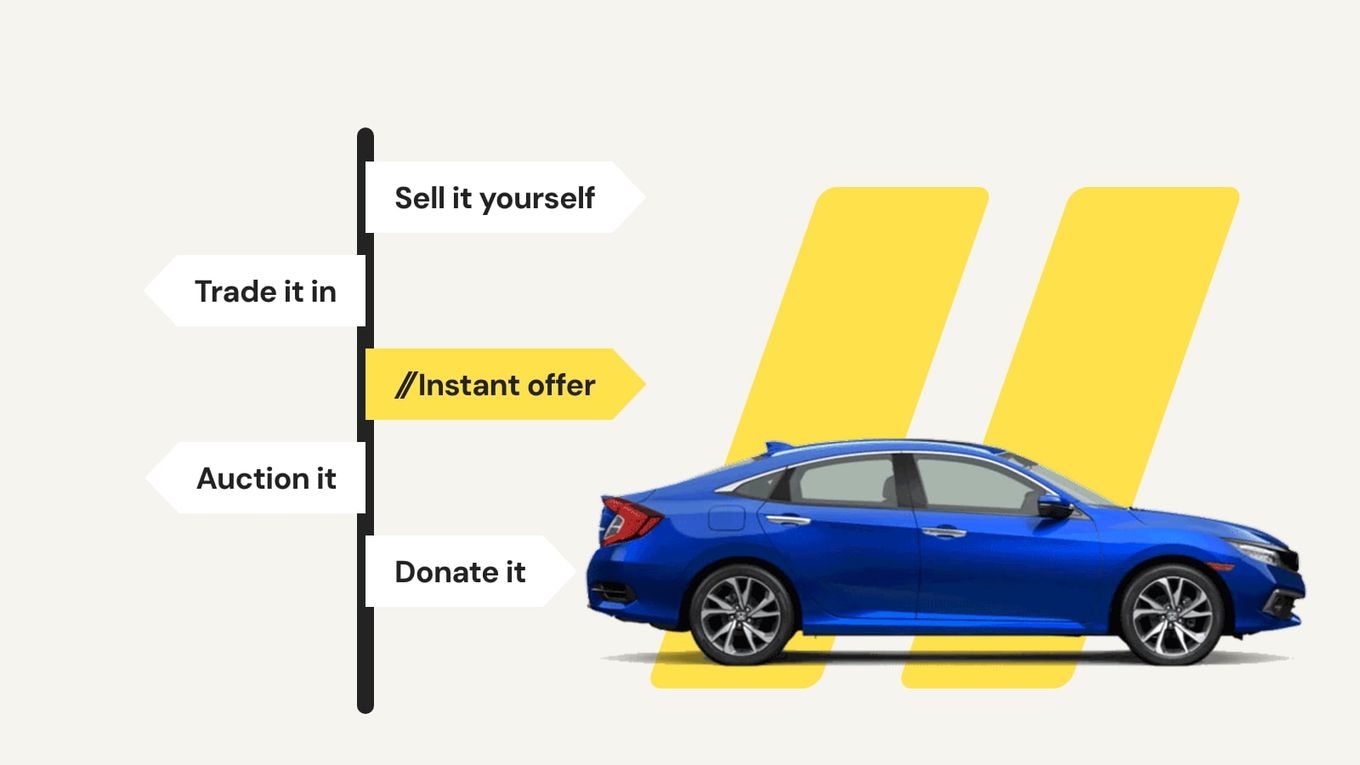
If you want the most money and have the time, sell it yourself: a private sale usually brings more than a dealer trade-in. If you want it done this week, get two or three instant offers online. They take minutes, cost nothing and are usually good for about a week. Trade it in only if you’re buying from a dealer and its number beats those offers. Auctions suit collector cars, and donating suits a car you’d rather give away.
Here’s how each one works, what it pays and what it asks of you.
The five ways, compared
| Way | What you get | How fast | What it takes | Best for |
|---|---|---|---|---|
| Sell it yourself | The private-party price, usually more than a trade-in | Days to weeks | Photos, ads, messages, test drives and checking the payment | A car in demand, if you have time |
| Trade it in | The trade-in value, as credit toward your next car | Same day as you buy | One visit, but you negotiate two deals at once | Buying your next car from a dealer |
| Instant offer | A written offer, usually good for 7 days | An offer in minutes, usually paid at handoff | A short online form, then an inspection | Selling soon without listing it |
| Auction | Whatever bidders pay | A week of bidding, once the listing is accepted | Approval, photos and answering bidders’ questions | Collector and enthusiast cars |
| Donation | A tax deduction, often limited to what the charity sells it for | Varies by charity | Paperwork with the charity, and Form 1098-C for your taxes | A car you’d rather give away |
1. Sell it yourself
A private sale usually gets you the most. A trade-in “typically yields less money than selling to an individual,” Consumer Reports says. A dealer has to recondition the car and still make money reselling it, and selling it yourself keeps that margin.
What it costs you is time. You take the photos, write the ad, answer messages, ride along on test drives, negotiate, and make sure the money is real before you sign over the title.
- Where to list it. Facebook Marketplace is free, and Craigslist costs $5. See free car advertising websites for every site’s fees, and the scams that target private sellers.
- When to list it. Used-car prices usually rise the most in March and fall the most in October. See the best time to sell a car.
- If you still owe money on it. The lender releases its lien only once the loan is paid in full, so the buyer’s money has to pay it off first. Meeting the buyer at your lender’s office, or using an escrow service, keeps that safe for both of you. The lien release can take a while: U.S. Bank, for example, tells borrowers to allow up to 10 business days.
2. Trade it in at a dealer
A trade-in is the least work if you’re buying your next car from a dealer: one visit, and the dealer handles the paperwork. You get the trade-in value as credit toward the car you’re buying, which is less than the private-party price.
The sales-tax break depends on your state. “Michigan and many other states” charge sales tax only on the price of your next car minus your trade-in, which can make a trade-in worth more than its number suggests. California doesn’t. In the state tax agency’s example, a $20,000 car with a $4,000 trade-in is taxed on the full $20,000. Check your state’s rule before you count on it.
Negotiate the trade-in on its own. When the trade-in and the new car are discussed together, it’s hard to tell what you’re getting for either. Get instant offers first, so you walk in knowing what your car is worth to other buyers.
Watch out for negative equity. If you owe more on your loan than the car is worth, a dealer or lender “may offer to roll the balance of your existing auto loan into a new auto loan,” the Consumer Financial Protection Bureau says, but “this will make your new auto loan more expensive.” It can also be risky: in a CFPB study of loans from 2018 to 2022, buyers who rolled negative equity into a new loan were “more than twice as likely” to have the account sent to repossession within two years as buyers with a positive trade-in. And if a dealer promises to pay off your negative equity, the CFPB says to “make sure it’s not included in your new financing.”
3. Get an instant offer
You enter your license plate or VIN, answer questions about the car’s condition, and get an offer back, often in a couple of minutes. If you accept, the buyer inspects the car at pickup or drop-off and pays you. You don’t have to buy anything.
| Buyer | Who buys the car | Offer good for | Pickup or drop-off | How you’re paid |
|---|---|---|---|---|
| Carvana | Carvana | 7 days or 1,000 miles | Either | A check at handoff |
| CarMax | CarMax | 7 days | Either. At-home pickup covers most customers, and a fee could apply | Payment in hand at drop-off |
| Kelley Blue Book Instant Cash Offer | A participating dealer (Kelley Blue Book doesn’t buy cars) | 7 days | Drop-off at the dealer | A check, or credit toward a car there |
| CarGurus | Local dealers, in select markets | 7 days or 250 miles | Drop-off at the dealer | The same day |
| Peddle | Peddle, which focuses on older, damaged and non-running cars | A week to accept and schedule pickup | Free pickup | A check at pickup |
| Sell My Car Online (us) | Sell My Car Online | 7 days or 300 miles | Free pickup from your driveway | At pickup |
Offers can change at inspection. Every one of these depends on the car matching what you told them, and the price can change once the car is inspected. Describe the car honestly, dents and warning lights included, and the number you see is more likely to be the number you get.
Get more than one. Offers are free and take minutes, so two or three give you a real price to compare, including against a dealer’s trade-in number. In a Consumer Reports survey of more than 14,000 members, people who took an instant offer reported the highest satisfaction (62%), ahead of selling to an individual (58%), selling to a dealer (51%) and trading in (34%).
Sell My Car Online, the last row in the table, is one of these buyers too. Our offer is free and comes with no obligation, we pick the car up from your driveway for free, and we pay you at pickup. We need a valid title with no loans or liens on it, so if you still owe money, pay the loan off first.
4. Auction it
Online auctions suit collector and enthusiast cars, where bidders compete for something they can’t find on a dealer’s lot. On Bring a Trailer, the Classic package costs the seller $99 for a custom-written listing and a 7-day auction, and the buyer pays a 5% fee (at least $250, at most $7,500). Your car has to be accepted first. Cars & Bids runs similar auctions, focused on cars from the 1980s onward.
For an everyday car, an auction is mostly extra steps. Bidders on these sites are shopping for something special.
Or consign it
Some dealers will sell your car for you and keep a commission. Get the agreement in writing. In California, a dealer that takes a car on consignment needs a written agreement with required disclosures, and has to pay you within 20 days of the sale. Washington’s attorney general puts the main warning plainly: “Do not sign over the title” to the consignment dealer.
5. Donate it
Donating can make sense for a car that’s worth little to you, but the tax deduction is usually smaller than people expect. If you claim more than $500, the IRS lets you deduct the smaller of what the charity sells the car for and its fair market value, and you have to attach Form 1098-C from the charity to your return. If the charity sells it for $500 or less, you can deduct the smaller of $500 and the car’s fair market value. There are exceptions, for example when the charity uses the car itself.
How to choose
- You want the most money and have a few weeks: sell it yourself.
- You want it gone this week: get two or three instant offers and take the best.
- You’re buying your next car from a dealer: get instant offers first, then see whether the trade-in beats them once your state’s sales-tax rule is counted.
- You owe more than it’s worth: know the payoff amount before you talk to anyone, and read the CFPB’s warning above.
- It’s a collector car: look at an auction.
- It’s older or has high miles: get instant offers anyway. Older and high-mileage cars are welcome with us.
- You’d like it to do some good: donate it, and read the deduction rules first.
The paperwork, whichever way you sell
Dealers and online buyers usually handle most of this for you. In a private sale, it’s on you. For the full list, see what you need to sell a car. Rules vary by state; here’s how they work in California:
- The title. As the seller, you sign the title on line 1. If you’ve lost it, apply for a replacement (form REG 227).
- A loan. The lender has to release its lien. With an electronic title, California’s DMV issues the title to the owner automatically once the loan is paid off.
- Release of liability. Tell the DMV within 5 calendar days of the sale. Once it’s recorded, parking tickets, traffic violations and civil claims from after the sale are the buyer’s responsibility.
- Smog. You give the buyer a valid smog certificate. Cars less than four years old don’t need one; the buyer pays a smog transfer fee instead.
- Plates. In California, plates generally stay with the car. Some special plates, such as personalized ones, can be moved to your next car for a fee.
Do you pay tax when you sell your car?
Usually not. Most cars sell for less than their owners paid, and the IRS says “losses from the sale of personal-use property, such as your home or car, aren’t tax deductible.” If you sell for more than you paid, the profit is a capital gain and goes on your tax return.
If you’d rather not list it at all
An instant offer is the quickest way to find out what your car is worth today, and it’s a good number to have even if you end up selling privately.
Get a free offer from Sell My Car Online. It’s good for 7 days or 300 miles, there’s no obligation, we pick the car up from your driveway for free, and we pay you at pickup. If the number works, you’re done. If not, you know what a private sale or a trade-in has to beat.
Questions people ask
What’s the best way to sell a car?
It depends on what you want most. A private sale usually gets the most money but takes the most time. Instant offers are the fastest: an offer in minutes and payment at handoff. A trade-in is the least work if you’re buying from a dealer anyway, and in many states it cuts the sales tax on your next car.
Is it better to trade in or sell my car?
Selling usually gets you more. A dealer has costs to cover before reselling your car, and Consumer Reports says a trade-in “typically yields less money than selling to an individual.” A trade-in can close the gap in states that charge sales tax only on the difference, but California isn’t one of them. Get a few instant offers before you decide, so you know what the dealer’s number is up against.
How long is an instant offer good for?
About a week. Carvana guarantees its offers for 7 days or 1,000 miles, CarMax’s and Kelley Blue Book’s are good for 7 days, and CarGurus dealer offers last 7 days or 250 miles. Ours at Sell My Car Online are good for 7 days or 300 miles.
Can I sell a car I still owe money on?
Yes. “If you owe less than the value of the vehicle, you can sell it and use the proceeds to pay off the loan,” the CFPB says. Many dealers and online buyers pay the lender directly (we don’t: we need the lien released first). In a private sale, the lender is paid first and then releases the title. If you owe more than the car is worth, you’ll need to cover the difference.
Sources
Checked October 23, 2026.
- U.S. Bank: lien release timing
- Michigan Department of Treasury: Form 485, sales tax and trade-in allowances by state; California Department of Tax and Fee Administration: motor vehicle dealers and Publication 34
- Consumer Financial Protection Bureau: trading in a car that isn’t paid off, if you can’t make your car payments and negative equity in auto lending (June 2024)
- Consumer Reports: get more money for your used car (April 15, 2025)
- The instant-offer table comes from each buyer’s own website and filings. We don’t link to other car buyers.
- Bring a Trailer: how it works
- California DMV: consignments, title transfers, private-party sales, electronic lien and title, release of liability, smog inspections and license plates
- Washington State Attorney General: consigning a car
- IRS: Publication 526, charitable contributions and Topic 409, capital gains and losses